
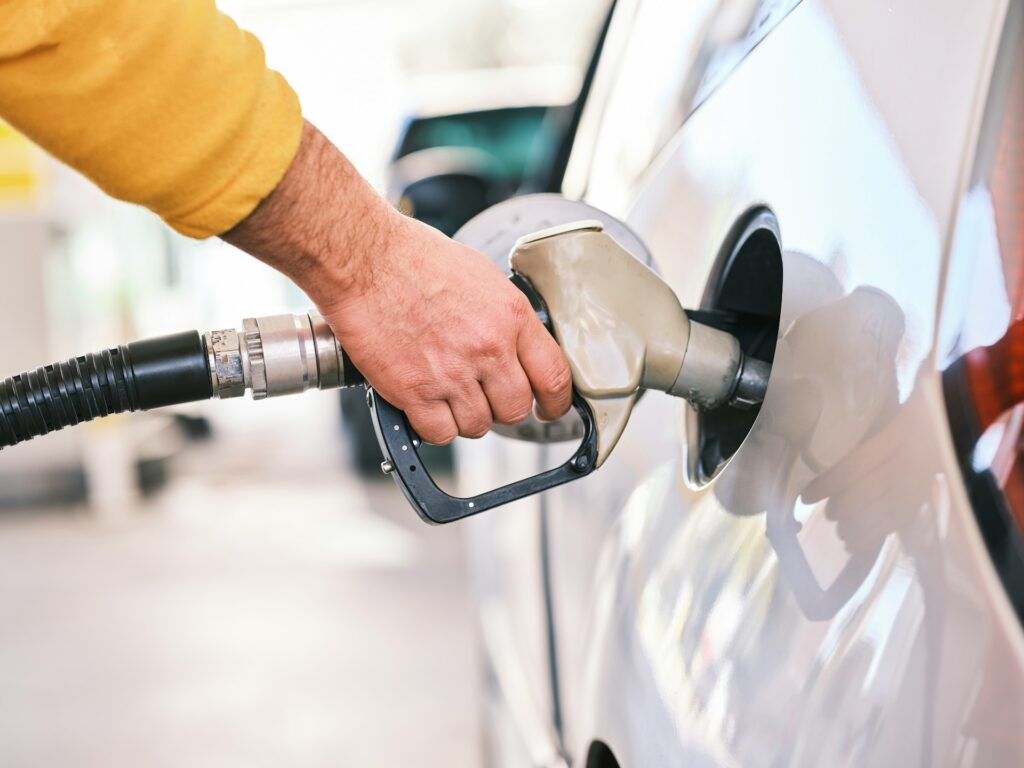
A New York startup called Aircela built a refrigerator-sized machine that makes gasoline with three ingredients: air, water, and electricity. The device produces 3.8 liters a day of a fuel that anyone can pour into their vehicle’s tank without modifying the engine. The prototype is based on the work of physicist Klaus Lackner, a pioneer of direct air capture, and has already attracted major investors.
A refrigerator that distills fuel
By: Gabriel E. Levy B.
On May 22, 2025, on a rooftop in Manhattan’s Garment District, a white box of hexagonal modules filled a glass bottle with freshly made gasoline. No one brought oil. The machine took carbon dioxide from the air, hydrogen from water and energy from the stream, and with those ingredients assembled the fuel molecules in front of investors, officials and the press. That day no car started with the liquid; The scene consisted of seeing gasoline coming out of a box connected to the wall, and that was enough to grab headlines.
Behind the device is Aircela, the company that husband and wife Eric and Mia Dahlgren founded in 2019 and that today brings together about fifteen people with a workshop in Manhattan itself. The promise is concrete: a fuel factory the size of a refrigerator, with a pump included and the capacity to store up to 64 liters, which works with a plug and a water tap in any garage, farm or cellar.
Can such a device save the combustion engine that Europe plans to bury?
The chemical recipe
The process brings together three known technologies in a single cabinet. First, a fan pushes air through a solution of potassium hydroxide, an alkaline salt that traps carbon dioxide like a sponge; the machine captures about ten kilos of CO₂ per day. Second, an electrolyzer splits water into oxygen and hydrogen using electricity, preferably solar or wind. Third, a reactor combines CO₂ with hydrogen to form methanol, and a catalyst converts that methanol into gasoline. The water enters the chain twice: in the chemical sponge and in the electrolyser.
The result is surprising for its normality. The fuel comes out with an octane rating of 90 to 95, without sulfur, ethanol and heavy metals. It can be mixed with regular gasoline or used neat, and can be used in any engine without touching a single piece. If the CO₂ came out of the air and the electricity came from the sun, burning that liter returns to the atmosphere the same carbon that the machine took from it: the account closes at zero.
The surname behind the invention
The background science belongs to Klaus Lackner, a physicist at Arizona State University and the father of direct air capture. Lackner proposed in the 1990s that machines could filter CO₂ from the atmosphere, an idea that his colleagues took as a joke and that today moves billions of dollars. Its «mechanical trees», towers of discs that trap carbon with the help of the wind alone, are the direct antecedent of this refrigerator. In Aircela he appears as a scientific advisor and inventor of the capture system.
The lineage goes back a long way. Eric Dahlgren is the great-grandson of Svante Arrhenius, the Swedish Nobel laureate who in 1896 first calculated how much CO₂ could warm the planet. The bet convinced the Danish shipping company Maersk, which contributed about $5.5 million, and names such as Chris Larsen, founder of Ripple, and investor Jeff Ubben. Even Karl Dums, who headed Porsche’s synthetic fuels program, went from skepticism to public praise.
The uncomfortable numbers
Physics takes its toll. Producing one gallon (3.8 liters) consumes about 75 kilowatt hours of electricity, and that gallon holds only 37: half of the energy is lost in the process, and the engine then wastes another two-thirds in the form of heat. With those same 75 kilowatt hours, an electric car travels about 400 kilometers; the gallon of Aircela moves a conventional vehicle about 56. The device, in addition, takes a whole day to produce what a dispenser dispenses in seconds.
The European organization Transport & Environment did the full math: powering combustion cars with these fuels requires almost four times more renewable electricity than moving electric cars the same distance. Added to that bill is the price of the machine, between $15,000 and $20,000 per unit, although the company estimates that, with its own solar panels, the energy cost of each gallon would drop by $1.50.
A niche with a future
Where does it make sense then? In places where the cable does not reach. Farms and mines far from the grid, islands that import diesel by boat, agricultural machinery and the millions of classic cars that no one is going to convert to electric. Also in Europe, where the rule banning the sale of new combustion cars from 2035 left a door open to those who use carbon-neutral fuels, and where Brussels proposed in December 2025 to soften that goal. For Latin America, with extensive rural areas and incomplete electricity grids, the model is at least worth studying.
Aircela competes against giants. Porsche and HIF produce synthetic fuel at a plant in Chilean Patagonia, and Infinium builds the world’s largest synthetic fuel factory in Texas. The New York startup is betting on the opposite: small, mass-produced machines like solar panels and installed right where the fuel is needed. The first commercial units would arrive at the end of 2026.
In short, Aircela proved that making gasoline with air, water, and electricity is possible, and that technical feat deserves attention. Another thing is that it is sensible on a large scale: each liter requires twice the energy it returns, and that account favors the electric car. The invention aims at the niches where the battery does not reach, and there, rather than saving the combustion engine, it could give it a dignified old age.
References
- (2025). Frequently Asked Questions. aircela.com.
- (May 22, 2025). First U.S. Machine to Turn Air into Gasoline Debuts in NYC. GlobeNewswire.
- The Autopian. (2025). A Company Wants To Sell You A Small Machine To Make Gasoline Out Of Air.
- (June 4, 2025). Aircela demonstrates prototype device that turns air into fuel.
- Interesting Engineering. (2025). Fridge-sized machine produces clean gasoline from air and CO2.
- Transport & Environment. Analysis of the energy efficiency of synthetic fuels in transport. transportenvironment.org.
- (December 16, 2025). EU carmakers to comply with 90% emissions reduction by 2035 as full combustion engine ban scrapped.
- HIF Global. HIF Haru Oni. hifglobal.com.
- Arizona State University News. (2020). Researchers pinpoint how sorbent materials catch and release carbon.