
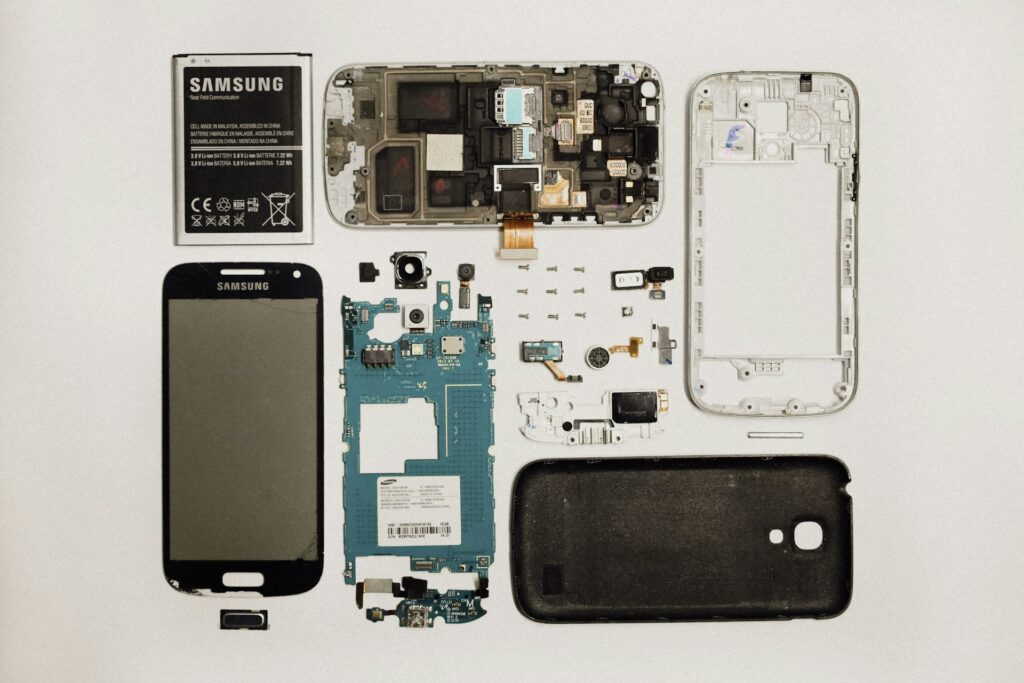
There is something that few people know when they keep a broken phone in the drawer of the bedside table or leave it forgotten in a closet: that device contains gold, silver, cobalt and dozens of minerals that any mining company would envy.
According to figures from the WEEE Forum and the International Telecommunication Union, around 5,300 million mobile phones stopped being used in 2022 alone. If they were stacked on top of each other, the tower would reach the Moon and return several times.
What’s inside that phone you don’t use anymore
By: Gabriel E. Levy B.
An average smartphone contains between 24 and 36 milligrams of gold, up to 340 milligrams of silver, between 9 and 15 grams of copper, and materials such as cobalt, lithium, neodymium, and praseodymium, which are rare earths used in magnets and displays. In total, more than 60 elements of the periodic table fit in the palm of your hand. At current prices, recoverable metals from a single cell phone are worth between 12 and 15 dollars.
That sounds like little, until you look at it on a scale. A ton of recycled phones contains between 140 and 368 grams of gold, that is, between 50 and 80 times more than a ton of ore extracted from a conventional mine.
Experts call this «urban mining»: the extraction of valuable materials directly from the technological waste generated by modern life, without digging a single meter of earth.
The global numbers are overwhelming.
The Global E-Waste Monitor 2024 reported that the materials contained in the 62 million tons of e-waste generated in 2022 had an estimated value of $91 billion. However, only 28,000 million were recovered. The other 63,000 million ended up buried, burned or stored without any use.The medals that were born from a drawer
The best-known example of large-scale urban mining has a Japanese stamp. For the Tokyo 2020 Olympic Games, the government called on citizens to donate their old devices. The response was massive: 6.21 million phones and almost 79,000 tons of electronic devices.
From all this material, 32 kilograms of gold, 3,500 of silver and 2,200 of bronze were extracted, enough to make the approximately 5,000 medals of those games. It was the first time in Olympic history that the medals were made entirely with recycled metals donated by the population.
It is not an isolated case.
The Belgian company Umicore generates 78% of its revenue from the recycling of electronic materials. Apple dismantles up to 1.2 million iPhones a year with its Daisy robot, capable of disassembling a phone in just 18 seconds to recover tungsten, rare earths and cobalt. Samsung, for its part, launched a circular battery chain in Vietnam in 2025 that recycles cobalt with an efficiency of more than 90%, and its Galaxy S25 already incorporates half of this mineral in a recycled version.
Latin America: A Wealth That Is Thrown Away
The region generates about 4 million tons of e-waste each year. But only between 3% and 4% are managed formally. The rest ends up in open-air landfills, in the hands of informal recycling or simply accumulated in homes without anyone taking advantage of it. According to UNITAR data, recoverable materials in electronic waste in just 13 Latin American countries exceed 1,700 million dollars per year. That money is literally being buried.
Still, there are encouraging signs. Chile implemented an Extended Producer Responsibility Law and today operates recycling points in 92 stations of the Santiago Metro.
In Colombia, the company Refurbi went from invoicing 220 million pesos in 2019 to 13,000 million in 2022 by refurbishing devices to give them a second life. Brazil has an electronic recycling market valued at 761 million dollars. The region’s potential far exceeds what is being tapped.
The invisible cost of not recycling
When a cell phone arrives at a landfill, its components release lead, mercury, cadmium and brominated flame retardants that contaminate soil and water sources for decades.
E-waste is responsible for approximately 70% of the hazardous toxic pollutants detected in certain ecosystems.
In areas where informal open-air recycling is practised, lead concentrations have been measured up to 200 times above safe limits for human health.
The contrast with formal recycling is abysmal.
Recovering gold from a cell phone generates 99% fewer emissions than extracting it from a mine. Recycled aluminum consumes 95% less energy than primary aluminum.
Overall, proper e-waste management prevented the emission of 93 million tonnes of CO2 and the extraction of 900 million tonnes of virgin ore in 2022.
A business of the future that has already arrived
The global e-waste management market could exceed $225 billion by 2034, according to projections by firms such as IMARC Group and Mordor Intelligence. New technologies such as bioleaching, which uses microorganisms to separate metals, advanced hydrometallurgy, and artificial intelligence applied to component classification are making the process increasingly efficient and less polluting.
In Latin America, where the volume of e-waste is projected to reach 9 million tons annually by 2033, the sector is still in its infancy, but that also means there is huge room for entrepreneurs, companies, and governments that want to bet on this model. The circular economy does not ask for technology to stop being consumed. Just ask that it stop wasting it.
That phone that’s more than two years old in a drawer isn’t junk. It is a small, portable and forgotten mine. And in the world to come, knowing how to take advantage of it well can make a huge difference, both for the planet and for the pocket.
In short, old or outdated phones contain more than 60 elements of the periodic table, including gold, silver, cobalt, and rare earths. A ton of cell phones has up to 80 times more gold than one of mining ore. The global market for electronic recycling exceeds 40,000 million dollars per year and is growing steadily. Latin America wastes 97% of its e-waste, although cases such as Colombia, Chile and Brazil show that the business is already a profitable and environmentally necessary reality.
References
IMARC Group. (2024). E-Waste Management Market Size, Share Report 2026-34. https://www.imarcgroup.com/e-waste-management-market
IMARC Group. (2024). Latin America E-Waste Management Market 2033. https://www.imarcgroup.com/latin-america-e-waste-management-market
Mordor Intelligence. (2024). E-Waste Recycling Market Size, Forecast, Share. https://www.mordorintelligence.com/industry-reports/e-waste-recycling-market
Phys.org. (2022). 97% of Latin America’s e-waste is improperly managed and includes an annual $1.7 billion in recoverable materials. https://phys.org/news/2022-01-latin-america-e-waste-improperly-annual.html
Samsung Newsroom. (2025). Samsung advances circularity with a new cobalt recycling process for Galaxy S25. https://news.samsung.com/uk/samsung-advances-circularity-with-a-new-cobalt-recycling-process-for-galaxy-s25
Snopes. (2021). Are Tokyo Olympic medals made from recycled phones? https://www.snopes.com/fact-check/tokyo-medals-recycled-phones/
UNITAR / ITU. (2024). The Global E-Waste Monitor 2024. https://www.itu.int/en/ITU-D/Environment/Pages/Publications/The-Global-E-waste-Monitor-2024.aspx
WEEE Forum. (2022). Of ~16 billion mobile phones possessed worldwide, ~5.3 billion will become waste in 2022. https://weee-forum.org/ws_news/of-16-billion-mobile-phones-possessed-worldwide-5-3-billion-will-become-waste-in-2022/