
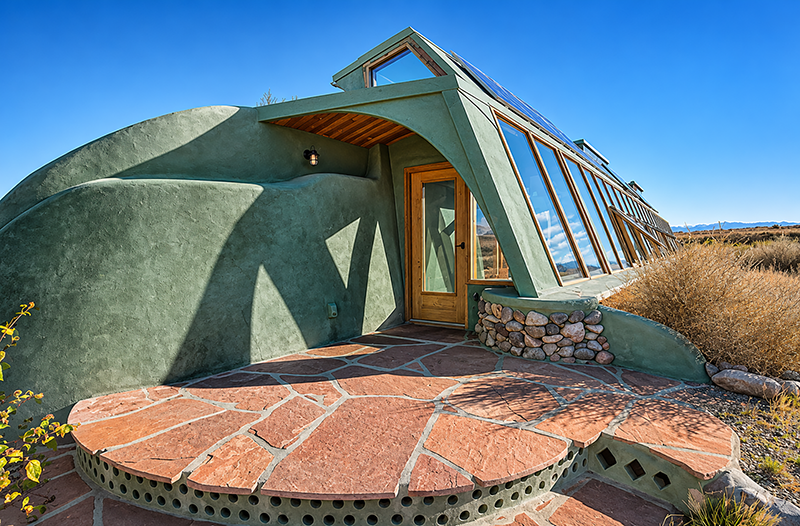
Latin America and the Caribbean produce more than 540,000 tonnes of garbage every day, while the construction sector, according to the United Nations, already accounts for close to 37 percent of global carbon dioxide emissions, and in between those two figures a method born half a century ago in the New Mexico desert, which raises houses out of tires, bottles, cans and rammed earth, is once again drawing the attention of architects and urban planners across the region.
This leads us to an unavoidable question:
Can houses built out of garbage become a serious answer for the cities of Latin America and the Caribbean?
Garbage and heat in the region
By: Gabriel E. Levy B.
The figure of 541,000 tonnes a day comes from the report Waste Management Outlook for Latin America and the Caribbean, published by UN Environment in 2018 with data from 2014, that is, a number that is already more than a decade old and that surely falls short today, since the agency itself projected that the region would exceed 670,000 tonnes a day by 2050.
The truth is that close to 90 percent of that garbage ends up in final disposal sites, a category that includes technically managed landfills but also open dumps, which receive some 145,000 tonnes every day, while the region recovers barely 10 percent of what it throws away.
The climate tightens and construction emits
To those figures we must add the report State of the Climate in Latin America and the Caribbean 2025, which the World Meteorological Organization presented in Brasilia in May of this year and which documents the passage of Hurricane Melissa as the first Category 5 storm ever to make landfall in Jamaica, with losses close to 41 percent of the island’s gross domestic product, along with the retreat of the Andean glaciers that supply water to some 90 million people.
Likewise, the United Nations Environment Programme and the Global Alliance for Buildings and Construction published in May 2026 their 2025-2026 status report, titled Building fast, falling short, in which they attribute to the sector close to 37 percent of global carbon dioxide emissions and warn that the world builds some 12.7 million square meters every day, that is, the equivalent of raising a city the size of Paris almost every week.
The brick made of cans
Michael Reynolds, an American architect based in Taos, New Mexico, began experimenting in the early 1970s with blocks made from beer cans, an invention he patented in 1973, and from there he spent more than five decades developing what he named the Earthship, a term that designates a partially buried house, oriented toward the sun, glazed along its front and built largely out of waste.
How an Earthship works
The principle is simple to explain though demanding to build, since the builders raise the rear walls with used tires packed with earth pounded in by sledgehammer, which turns each tire into a block of more than 100 kilos that stores the heat of the day and releases it at night, while the glass facade facing the sun works as a greenhouse that warms the house and allows food to grow inside it.
The design adds solar panels and a roof that collects rainwater and uses it up to four times, that is, for drinking, for watering the indoor plants that filter that greywater, for the toilets and finally for an outdoor septic system, so that the home runs without connecting to the public water and power grids or to the sewer, and Reynolds sums all of this up in six needs that, in his view, people in every country share, shelter without fossil fuels, electricity, water, food, wastewater treatment and something to do with what we call garbage.
Earthship Biotecture, the firm Reynolds founded in Taos, claims to have built in more than 40 countries and its promoters speak of around 3,000 Earthships worldwide, a figure that no independent registry has so far been able to confirm.
Landing in Latin America
The official record of Earthship Biotecture shows that the firm’s first construction in the region was in La Paz, Bolivia, in 1992, long before the method made headlines, and that it was followed by Tegucigalpa in 1999, three projects in Mexico between 2001 and 2009, San Juan del Sur, in Nicaragua, in 2007, and Comalapa, in Guatemala, in 2013.
From the Southern Cone to the Caribbean
The media breakthrough came with the Southern Cone, since in January 2014 Reynolds raised an Earthship in Ushuaia and in 2016 he inaugurated in Jaureguiberry, Uruguay, what the regional press presented as the first self-sustaining public school in Latin America, a 270-square-meter building that the organization Tagma raised in seven weeks with hundreds of volunteers, a school that Tagma itself replicated in Mar Chiquita, in the province of Buenos Aires, in 2018, the same year the firm arrived in Aguada, Puerto Rico, a few months after Hurricane Maria, to build a community center designed to withstand hurricanes.
Personally, I believe the list should be read calmly, since in more than thirty years the firm itself records some fifteen projects in the region, mostly schools, community centers, demonstration spaces and private homes, none of them part of a mass housing program, so that we are looking at a valuable seed that has not yet reached the scale of a regional trend, though it has reached the scale of a conversation worth having.
What the science says
While the academic studies that have measured the thermal behavior of these houses are still few, they agree that the model works very well where it was born, especially in dry climates with abundant sun, since Martin Freney, Veronica Soebarto and Terry Williamson, of the University of Adelaide, monitored an Earthship in Taos throughout 2012 and then simulated the same design in several European cities, concluding that the building stays comfortable without heating or air conditioning as long as it receives enough solar radiation, whereas where cloudy skies prevail it needs backup heating, a finding that Kenneth Ip and Andrew Miller, of the University of Brighton, had anticipated in 2009 when they measured the Earthship built in that English city.
The challenge of the humid tropics
Almost none of those studies, however, resolves the case of the humid tropics, where much of the population of Latin America and the Caribbean lives, since a tire wall that stores heat and a sun-facing glass greenhouse are virtues in the desert and require major adaptations in Barranquilla, Guayaquil, Managua, Santo Domingo or Panama City, where the challenge for any home is to get heat and humidity out, so that the question of how to adapt the model to these climates remains open and is, in our view, the most interesting one for our region.
Costs and codes
It is equally worth talking about money, since the house made of garbage turns out to be less economical than its name suggests, with Earthship Biotecture itself quoting around 400 dollars per square foot for its standard model, that is, more than 4,000 dollars per square meter in the United States, and although self-construction with volunteers brings that figure down considerably, every Latin American project has required between 70 and 200 people working for weeks on end, a scheme that works very well for a school or a community center and that will eventually have to find the formula to replicate itself at the scale of a city.
In this case the building codes also weigh in, since in Colombia the Earthquake-Resistant Construction Regulation, the NSR-10, does not explicitly recognize earth-filled tire walls as a structural system, which requires special approval procedures and often becomes a headache for anyone who wants to raise one of these houses, and something similar happens across much of the region, where the method remains an exception that the authorities study case by case.
The lesson for cities
For those of us who think about cities, and just as we analyzed on this portal when we looked at the plastic-block houses of Costa Rica, the most useful lesson of these buildings lies in their principles more than in their materials, that is, capturing rainwater on every roof, designing with the sun and the wind before switching on the air conditioning, reusing greywater, growing food in the building itself and treating waste close to where it is produced, ideas that a dense city can apply in its existing buildings without ramming a single tire, especially in a region whose climate is changing faster than its codes.
In short, Michael Reynolds’s Earthships are a seductive idea in a region that produces more than half a million tonnes of garbage a day and suffers an increasingly extreme climate, the academic studies confirm that they work in dry, sunny climates, though they have yet to prove their performance in the humid tropics, while their cost demands a larger investment than their fame suggests.
It remains to be seen whether the region can adapt the Earthship to its coasts and its hot cities, since in that case the garbage that overwhelms us today could become, at least in part, a roof for those who have the least.
References
- Al Jazeera. (2018, May 15). Meet the couple bringing Earthships to hurricane-hit Puerto Rico. https://www.aljazeera.com/features/2018/5/15/meet-the-couple-bringing-earthships-to-hurricane-hit-puerto-rico
- (2016). Latin America’s first Earthship is a sustainable school built from found materials. https://www.archdaily.com/tag/earthship-biotecture
- Earthship Biotecture. (2026). Media: We have built Earthships all around the world. https://earthship.com/media/
- Earthship Biotecture. (n.d.). Build: Earthship models. https://earthship.com/build/
- Freney, M., Soebarto, V., & Williamson, T. (2013). Thermal comfort of Global Model Earthship in various European climates. Proceedings of BS2013, 13th Conference of the International Building Performance Simulation Association, Chambéry, France, 1625-1632. https://digital.library.adelaide.edu.au/dspace/handle/2440/81746
- Ip, K., & Miller, A. (2009). Thermal behaviour of an earth-sheltered autonomous building: The Brighton Earthship. Renewable Energy, 34(9), 2037-2043.
- UN Environment. (2018). Waste Management Outlook for Latin America and the Caribbean. https://wedocs.unep.org/handle/20.500.11822/26436
- World Meteorological Organization. (2026, May 18). State of the Climate in Latin America and the Caribbean 2025. https://wmo.int/resources/publication-series/state-of-climate-latin-america-and-caribbean/state-of-climate-latin-america-and-caribbean-2025
- United Nations Environment Programme & Global Alliance for Buildings and Construction. (2026). Global Status Report for Buildings and Construction 2025-2026: Building fast. Falling short. https://www.unep.org/resources/report/global-status-report-buildings-and-construction-2025-2026