
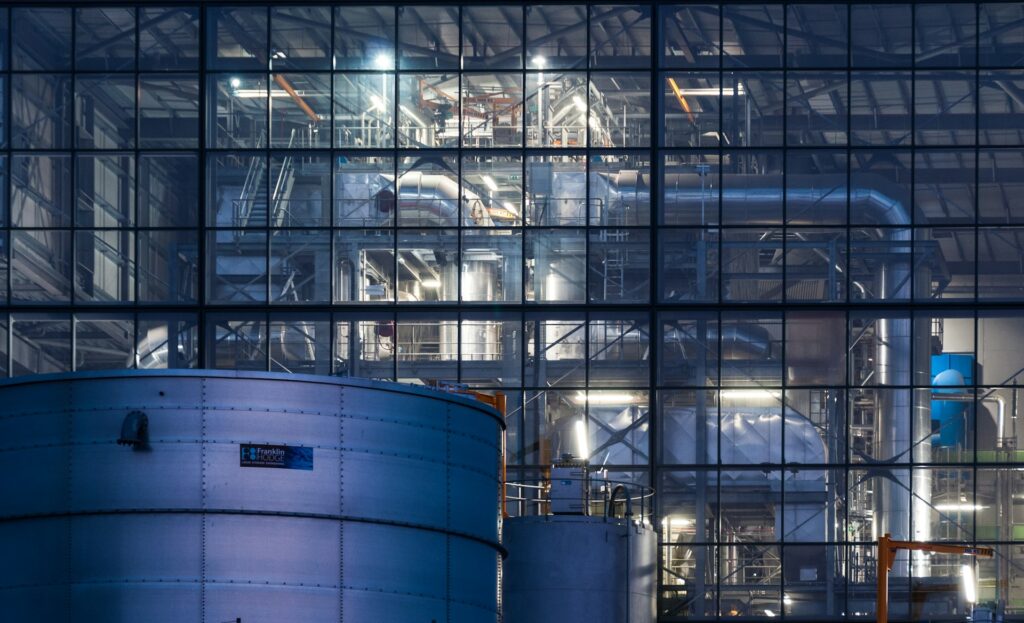
There are cities where garbage is no longer garbage. And it is not a cultural, social or disciplinary change, but a substantial improvement of a process that was previously the biggest headache of environmentalists in the world: Incineration Plants, which give an adequate end and with less pollution, for all those elements that cannot be recycled.
The Smart Transformation of Waste
By: Gabriel E. Levy B.
For decades, the word incinerator was synonymous with black smoke, invisible pollution and neighbors with banners.
And rightly so. Plants in the 1970s and 1980s released dioxins, heavy metals, and particles into the air without serious control.
In Germany, for example, facilities at that time emitted about 400 grams of dioxins per year in toxic equivalents. Today that figure is below 0.5 grams, although the installed capacity doubled.
It is not a miracle. It is hard regulation and total reinvention of the process.
The European Directive 2010/75/EU set the bar high: gases must be burned at no less than 850 degrees for at least two seconds, 16 different pollutants are monitored in real time and the limit for dioxins was 0.1 nanograms per cubic meter.
In the United States, reforms to the Clean Air Act called for reductions of 96% in dioxins and 93% in mercury.
Plants that did not meet those standards closed. Those that managed to do so operate with emissions that often not even the instruments can detect.
From the bag to the kilowatt
The process is brutal and elegant at the same time. The trucks unload into a closed pit with negative pressure, so that no odor escapes to the outside. A crane with tongs mixes the waste before releasing it into a mobile grill oven, where the temperature ranges from 850 to 1,100 degrees.
The gases from this combustion pass through a boiler that produces superheated steam to more than 440 degrees and 70 bars of pressure. That steam moves a turbine connected to a generator, the same cycle used by a coal-fired power plant, only with a different fuel: Monday’s garbage bag. Each ton of urban waste yields between 500 and 700 kilowatt hours. If the plant also uses waste heat for district heating, the total efficiency of the system reaches the range of 80 to 90%.
The long way to the fireplace
Before going into the air, the gases go through a purification process that is not improvised at all. First, selective catalytic reduction: Ammonia is injected onto a bed of titanium-vanadium catalysts, and that destroys up to 95% of nitrogen oxides and breaks down residual dioxins at the same time. Then come gas scrubbers, which neutralize sulfur dioxide, hydrochloric acid and fluorides with lime or soda.
Powdered activated carbon is then injected, which works like a chemical sponge capable of capturing mercury and persistent organic compounds. Finally, a fiberglass baghouse retains more than 99.9% of fine particles. What comes out of the chimney is not smoke in the old sense: it is hot water vapor, carbon dioxide and trace gases within legal limits, watched over by a continuous monitoring system that publishes its data in real time. At Amager Bakke, the iconic plant in Copenhagen, sulphur dioxide purification is close to 99.5%.
What Remains After the Fire
One ton of waste leaves about 200 to 250 kilos of bottom slag. None of that goes to the landfill. Countries such as the Netherlands, Belgium, Denmark and Germany value them almost 100% as aggregate in road subbases, engineering fills and some concretes. At the London 2012 Olympic Games, 30,000 tons of this slag were part of the Olympic Village.
The most curious thing happens before, when the slag is still hot. Electromagnets and eddy current separators extract between 20 and 30 kilos of iron and between 5 and 15 kilos of non-ferrous metals for each ton treated. A 2025 study published in Scientific Reports found concentrations of silver and gold in the ashes far higher than those in the Earth’s crust. They call it urban mining. In Europe alone, this metal recycling saves about 3.8 million tons of CO2 per year.
The plants that changed the sector
Some facilities have broken all the molds. CopenHill, opened in 2017 in front of the Copenhagen water, processes 560,000 tonnes per year, heats 160,000 homes and provides electricity to 62,500. On its roof there is an artificial ski slope and an 85-meter climbing wall. It is the most visited industrial building in Denmark.
Sweden has 34 such plants, sends less than 1% of its waste to landfill and imports almost four million tonnes of rubbish from other countries so as not to waste capacity.
Japan, with more than a thousand plants, integrated these facilities into the urban fabric decades ago: the one in Maishima, in Osaka, was designed by Friedensreich Hundertwasser as if it were a theme park; Toshima, within Tokyo, gives heat to a public swimming pool.
Singapore completed Tuas Nexus, the world’s first facility to combine wastewater treatment and solid waste recovery in a single enclosure.
In Paris, the Isséane plant operates 31 meters underground, with a landscaped roof and no trucks visible from the street.
Smart City Nodes
A modern plant is not an isolated element, it is a node. Its sensors are integrated with urban platforms, its turbines adjust their production to grid demand, and its steam feeds centralized heating networks that in Stockholm reach 90% of buildings. In addition, it reduces the volume of garbage by 90% and weight by 75%, frees up urban land and avoids the methane that landfills would emit for decades. Methane heats 28 times more than CO2.
There are serious criticisms.
Zero Waste Europe warns of the risk of overcapacity, and the European Union’s Green Taxonomy no longer funds new plants. These are legitimate debates. But as long as there is waste with no recyclable outlet, the choice is not between incinerating or recycling, but between incinerating well or burying. And burying, by any metric, is the worst option.
What used to come out of a chimney as a sign of damage, today comes out as almost clean steam from a power station that is also a ski slope, garden or museum. Imperfect, yes. But real. And it works.
In short, modern incineration plants ceased to be an environmental problem to become allies of smart cities. They burn waste at a thousand degrees, generate electricity and heat for thousands of homes, filter their gases with advanced technology and recover metals from ashes. They transform garbage into usable urban resources.
References
European Confederation of Energy Recovery Plants. (2017). Bottom ash fact sheet. CEWEP. https://www.cewep.eu/wp-content/uploads/2017/09/FINAL-Bottom-Ash-factsheet.pdf
European Confederation of Energy Recovery Plants. (2020). Energising waste: A win-win situation. CEWEP. https://www.cewep.eu/wp-content/uploads/2017/09/Energy-win-win-paper-April-2020.pdf
IEA Bioenergy Task 36. (2020). Trends and drivers in alternative thermal conversion of waste. IEA Bioenergy. https://www.ieabioenergy.com/wp-content/uploads/2020/09/Trends-and-drivers-in-alternative-thermal-conversion-of-waste.pdf
IEA Bioenergy Task 36. (2021). Waste-to-energy and social acceptance: CopenHill WtE plant in Copenhagen. IEA Bioenergy. https://www.ieabioenergy.com/wp-content/uploads/2021/03/T36_WtE-and-Social-Acceptance_Copnehhill-WtE-plant-in-Copenhagen.pdf
Lindström, E., et al. (2025). Statistical analyses of precious metal contents in waste incineration bottom ashes. Scientific Reports, 15. https://www.nature.com/articles/s41598-025-91855-7
National Research Council. (2000). Waste incineration and public health: Regulation related to waste incineration. National Academies Press. https://www.ncbi.nlm.nih.gov/books/NBK233621/
Schanes, K., & Stagl, S. (2019). Incineration versus recycling: In Europe, a debate over trash. Yale Environment 360. https://e360.yale.edu/features/incineration_versus_recycling__in_europe_a_debate_over_trash
State of Green. (2022). CopenHill: The story of the iconic waste-to-energy plant. https://stateofgreen.com/en/solutions/copenhill/