
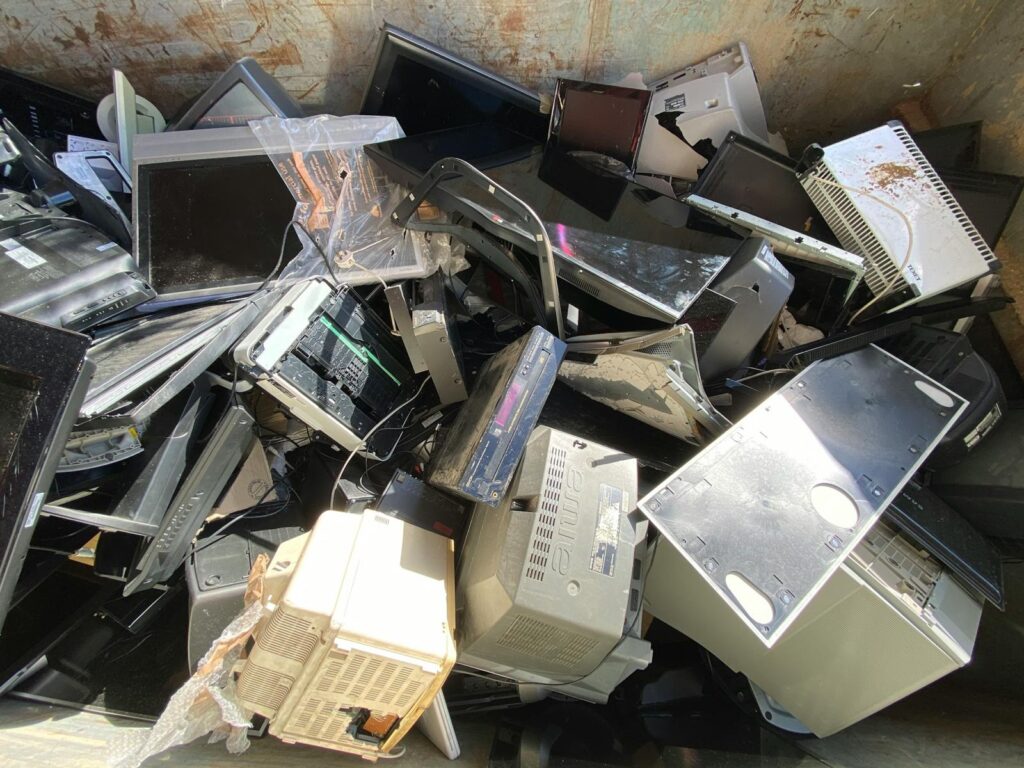
On the fringes of many cities in Latin America and the Caribbean, where streets lose names and asphalt dissolves into dirt, mountains of technological junk emerge.
Broken smartphones, notebooks, routers, vapes and even electric scooters coexist with chickens, skinny dogs and barefoot children.
They are the waste of the digital age, those that promised connectivity, productivity and modernity, but ended up polluting water, sowing diseases and causing fires.
«There is no outside for electronic waste»
By: Jorge Santkovsky and Gabriel E. Levy B.
The boom in waste electrical and electronic equipment (WEEE) is not a recent phenomenon, but its acceleration is.
According to the Global E-waste Monitor (2020), the world generated 53.6 million metric tons of e-waste in that year. Of that figure, only 17.4% was properly recycled. Latin America and the Caribbean contributed about 4.2 million tons, with a recycling rate below 3%.
«Every technology has a dark side,» warns Uruguayan researcher Eduardo Gudynas, and never before is this statement so literal: under the casing of a monitor or the circuit of a cell phone sleeps an invisible, chemical, sanitary and igneous threat. And the most serious thing: in Latin America and the Caribbean no one seems to be looking.
Despite being a region with increasing access to digital technologies, most Latin American countries do not have robust legislation on extended producer responsibility (EPR), as is the case in Europe.
In other words: the useful life of electronic products ends up in the hands of users, but also in the meagre budgets of municipalities.
In his essay «The Risk Society», the German sociologist Ulrich Beck points out that in advanced modernity environmental dangers are no longer collateral, but direct consequences of progress.
The case of WEEE confirms this thesis: it is not marginal waste, but central to the current consumption model.
«What is not seen, also contaminates»
The problem with e-waste is not just its volume, but its persistent and silent toxicity. When a television, a lithium battery or a printer ends up in an open-air landfill, a chain of invisible processes begins that affect both human health and the environment.
One of the most serious is leaching: the filtration of heavy metals, lead, mercury, cadmium, hexavalent chromium, from electronic components into the soil and groundwater. In agricultural areas, this can mean that those chemicals end up in food or drinking water.
Tube monitors (CRTs), now almost obsolete, contain leaded glass that, when broken, becomes a sharp, polluting and infectious trap.
In many countries, these fragments are scattered in landfills without any protective measures, within the reach of informal collectors and children.
And that’s not all: the plastic casings of televisions or CPUs, by retaining rainwater, become ideal breeding grounds for the Aedes aegypti mosquito, vector of dengue, Zika and chikungunya.
The combination of humidity, heat and e-waste is a perfect breeding ground for epidemic outbreaks.
The problem is exacerbated in the tropical regions of Central America and the Caribbean, where the lack of differentiated collection turns each storm into an opportunity for the massive reproduction of vectors.
«The valuable pays the dangerous»
Not everything in WEEE is risky. There are many more opportunities.
Each device contains valuable materials such as copper, silver, gold, and palladium, especially concentrated in electronic boards.
In fact, it is estimated that a ton of plates can contain more gold than a ton of ore mined from a mine.
However, as the Mexican environmental economist Alma Rocha points out in her work on the recovery of technological waste, this potential can only be exploited if the «positive» fractions (valuable and recyclable) are properly separated from the «negative» fractions (dangerous or expensive to treat).
What happens in most Latin American countries is the opposite: WEEE arrives mixed with common garbage, damaged, wet or burned, which prevents its use.
The companies that could recycle these materials often do not have direct access to them, and the municipalities, overwhelmed, lack the logistics and technical knowledge to intervene.
Added to this is the existence of orphan waste: devices without an active manufacturer, without a visible brand or without attributable legal liability.
In the absence of a strong EPR law, no one actor takes over. The result is that only waste «with an owner» is managed; the rest ends up in oblivion.
As the Argentine political scientist Enrique Viale argues, «environmental liabilities are not errors of the system, they are consequences of an economic model that externalizes its costs.»
WEEE, in Latin America, is exactly that: a liability that no one wants to recognize.
«When lithium burns»
One of the most recent, and most invisible, risks of electronic waste is that of lithium batteries.
These small sources of energy are present in almost all modern devices: cell phones, tablets, laptops, electronic cigarettes, scooters, skateboards, cameras.
But when they are thrown away with common garbage, they become real time bombs.
In Colombia, a collection truck caught fire in Medellín when a battery was compacted along with the waste.
In Brazil, an explosion in São Paulo, caused by an electric bicycle battery, leveled an informal recycling center.
In Peru and Mexico, entire landfills burned due to punctured or crushed batteries.
Lithium batteries, when compressed, knocked or exposed to extreme heat, can generate internal short circuits and cause uncontrolled thermal reactions.
The consequence is not only the fire, but the release of toxic gases such as hydrogen fluoride.
And here the problem becomes circular: poorly managed technological waste not only pollutes, but also destroys the few recycling attempts that exist.
Every fire at a collection or recycling center is a setback for the entire system.
The lack of adequate infrastructure for the safe handling of batteries makes these devices silent enemies, hidden among seemingly harmless waste.
«In addition to the threat of fires and pollutants, there is another less attended but no less disturbing one: WEEE accumulated in improvised landfills create dry, dark and protected environments that act as a refuge for rats, cockroaches, but also – in some tropical areas of Central America and the Caribbean – for snakes. These reptiles, attracted by the shade and heat retained by plastic waste, have appeared in municipal landfills near popular neighborhoods, generating health alerts and avoidable accidents. Technological waste, thus, not only pollutes or sets fires: it also bites.»
In conclusion, e-waste management in Latin America and the Caribbean represents one of the most urgent environmental, health, and logistical challenges today.
Not because of their visibility, but because of their ability to act in silence: contaminating soils, sickening bodies, starting fires, collapsing systems.
But all is not lost. Solutions exist, and many are already within reach: from public-private partnerships to extended producer responsibility laws.
The obstacle is not technological, but organizational.
It is time to transform these toxic liabilities into circular assets.
E-waste can cease to be a threat, if we learn to see it before it explodes.
References
- Beck, Ulrich (1986). The risk society. Towards a new modernity. Paidós.
- Gudynas, Eduardo (2011). Buen Vivir: Germinating alternatives to development. Latin America on the Move.
- Rocha, Alma (2019). «Electronic waste in Latin America: diagnosis and opportunities». National Autonomous University of Mexico.
- Global E-waste Monitor (2020). «The Global E-waste Statistics Partnership (GESP)». United Nations University.
- Jorge Santkovsky (2025). «The Dark Side of Waste». Lags Argentina. https://www.rezagos.com/