
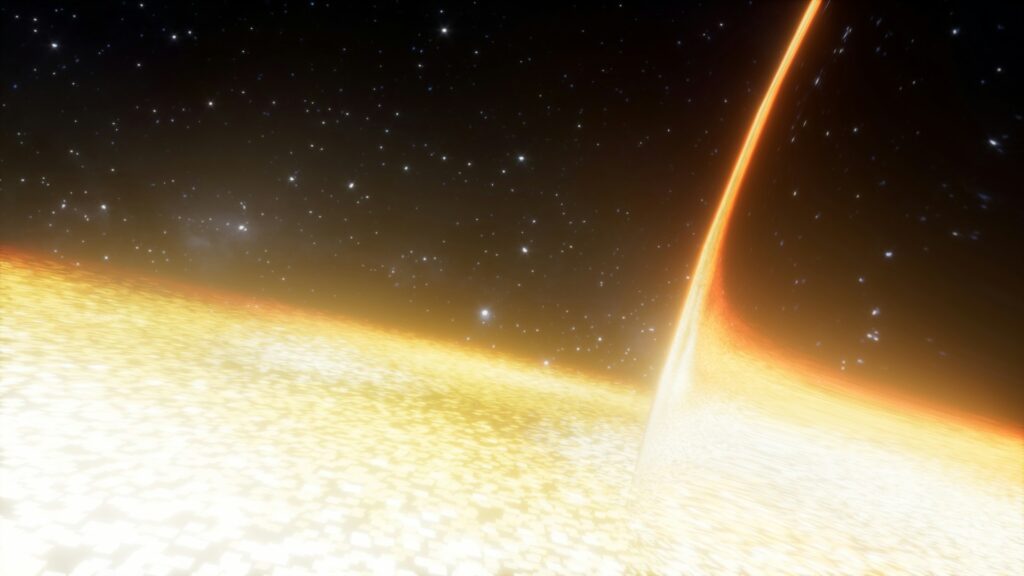
A solar flare may seem like a distant, almost poetic phenomenon.
But when its coronal mass ejection travels directly toward Earth, the story changes tone.
The auroras that promise to illuminate the sky are accompanied by an invisible threat: a possible technological disruption that puts in check the so-called «smart cities», those cities that have delegated their vital functioning to interconnected digital networks.
«Modernity has left us blind to the sun»
By: Gabriel E. Levy B.
On March 13, 1989, a solar storm knocked out power to more than six million people in Quebec, Canada.
The power grid collapsed in less than two minutes.
What seemed like an exceptional event, more typical of a science fiction story, was the result of a geomagnetic storm caused by a coronal mass ejection. That storm not only darkened cities, but also disrupted radio signals, navigation systems and satellite networks.
Decades later, in the midst of the era of hyperconnectivity, these storms have not ceased to exist.
In fact, solar physicist Daniel Baker, from the University of Colorado, warned in 2019 that the conditions are ripe for a solar superstorm comparable to that of 1859, known as the Carrington Event. Then, the telegraph, the cutting-edge technology of the time, collapsed globally, with operators receiving electric shocks and cables burning.
The difference is that today we don’t use telegraph cables: we use artificial intelligence, 5G networks, distributed sensors, autonomous vehicles, video surveillance cameras, automated transportation systems, and thousands of interconnected applications that allow a city to «think» and make decisions in real time.
The smart city revolution, according to Carlo Ratti, director of MIT’s Senseable City Lab, is based on «digitizing urban space.» But what happens when a solar storm interrupts that digitalization?
«What is not seen, also burns»
Solar storms, more precisely called geomagnetic storms, are the result of disturbances in the Earth’s magnetic field caused by emissions from the Sun.
When a coronal mass ejection reaches Earth, it generates induced geomagnetic currents that can damage electrical transformers, disrupt satellites, and destabilize global positioning systems (GPS).
All this in a matter of hours.
The problem for smart cities is structural. These smart cities operate on a foundation of technologies that require constant connectivity, low latency, and large volumes of data.
A simple blackout or error in geolocation can collapse the automated transportation system, disrupt smart power distribution, or desynchronize surveillance and emergency systems.
As the urban planner and resilience expert Judith Rodin explains in her book The Resilience Dividend (2014), «digital interdependence increases the fragility of urban systems». This statement takes on a new meaning when faced with the unpredictable impact of space phenomena.
The Karlsruhe Institute of Technology (KIT) in Germany has developed simulation models that show how an intense geomagnetic storm could disable up to 60% of low-orbit satellites in a critical scenario, directly affecting the Internet of Things (IoT), essential for the operation of urban sensors, waste management, public lighting and emergency services.
The spatial climate context, then, becomes a crucial variable for the design and operation of smart cities. But, so far, it does not appear as a central axis in urban planning manuals.
«Intelligence can also be vulnerable»
A smart city doesn’t just depend on algorithms and sensors; also of the stability of the infrastructures that sustain them.
This dependence is what reveals a critical weakness in the face of events such as solar storms.
Researchers from the Institute of Applied Physics of the Russian Academy of Sciences have documented how variations in the Earth’s magnetic field alter the behavior of high-voltage power grids.
These disruptions are not limited to causing blackouts: they also affect the performance of SCADA (Supervisory Control and Data Acquisition) systems, which control everything from water treatment plants to the flow of vehicular traffic in many modern metropolises.
In the words of researcher David Wallace-Wells, author of The Uninhabitable Earth (2019), «the threat does not always come from total collapse, but from the sudden interruption of the normal rhythm».
A city powered by artificial intelligence can make automated decisions based on erroneous data if it comes from sensors interfered with by a geomagnetic storm. This could lead to unjustified traffic diversions, massive alarms, interruptions in hospital services or disconnection of autonomous power grids.
In cities such as Singapore, Amsterdam or Barcelona, considered benchmarks for smart cities, the levels of automation are so high that a prolonged interruption of their interconnected systems could become a national security problem.
And yet, few of these cities include solar storms in their risk maps or cyber resilience protocols.
The paradox of urban intelligence is that, by delegating functions to automated systems, the human response capacity in the event of a failure is lost. As Evgeny Morozov pointed out in his work To Save Everything, Click Here (2013), the obsession with technological solutions makes invisible the need for redundant systems and analog emergency protocols.
«Lights in the sky, shadows in the city»
Recent cases show how these threats are not hypothetical. In May 2024, a G4-class solar storm disrupted aircraft navigation services in Scandinavia for more than six hours.
Although it did not cause accidents, flights had to be diverted and there were intermittent communication failures. The European Aviation Safety Agency (EASA) warned at the time that «intense solar storms could make automated routes unfeasible».
In 2022, the City of San Francisco experienced a partial outage in its smart street lighting network during a minor geomagnetic storm.
The cause was the saturation of data from sensors that, when receiving interference, sent erratic signals that overloaded the system. Although the blackout lasted only a few minutes, the failure was considered a warning.
In Japan, where cities such as Tokyo and Osaka have implemented distributed energy systems based on smart grids, geomagnetic blackout drills have begun to be tested. The Ministry of Science and Technology has issued recommendations to include space weather forecasting in critical infrastructure protocols.
Even private companies such as SpaceX had to face the reality of these phenomena. In February 2022, a solar storm destroyed 40 newly launched Starlink satellites, causing them to lose altitude and burn up in the atmosphere. This temporarily affected connectivity in rural areas of the United States and evidenced the fragility of the orbital support of many urban technologies.
In conclusion, solar storms, far from being harmless astronomical spectacles, represent a tangible threat to cities that have opted for total automation. In a smart city, the failure of a satellite, a transformer or an algorithm can trigger a cascade of dysfunctions. Twenty-first century urban resilience cannot do without space weather awareness. If we want our cities to be truly smart, they must also be able to withstand the fury of the Sun.
References:
- Ratti, C. & Claudel, M. (2016). The City of Tomorrow: Sensors, Networks, Hackers, and the Future of Urban Life. Yale University Press.
- Rodin, J. (2014). The Resilience Dividend: Being Strong in a World Where Things Go Wrong. PublicAffairs.
- Baker, D. et al. (2019). Space Weather Impacts on Modern Technology. Space Weather Journal, American Geophysical Union.
- Wallace-Wells, D. (2019). The Uninhabitable Earth: Life After Warming. Tim Duggan Books.
- Morozov, E. (2013). To Save Everything, Click Here: The Folly of Technological Solutionism. PublicAffairs.
- Karlsruhe Institute of Technology (KIT). (2022). Simulations of Geomagnetic Storm Effects on Urban IoT Systems.
- European Aviation Safety Agency (EASA). Solar impact report. June 2024.