
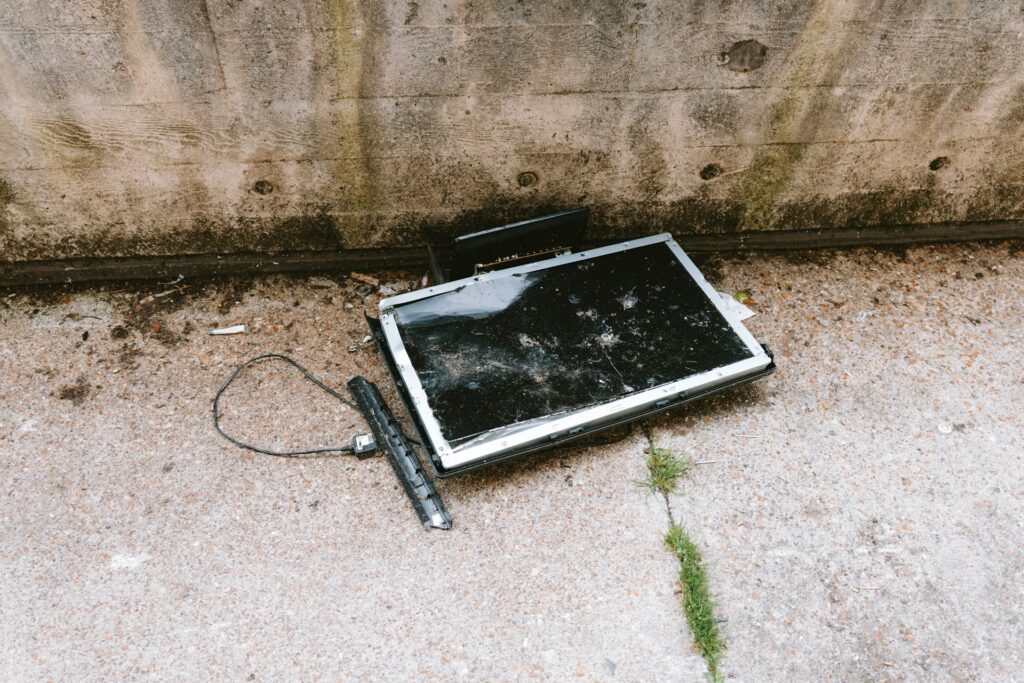
The television ceased to be the domestic altar where families congregated to become just another object of fleeting use, a victim of the logic of discarding.
While old tube TVs survived three or four repairs, modern LED TVs are abandoned due to minor failures or even not being able to install the latest application.
The circular economy faces one of its greatest challenges here: changing the consumer’s mentality.
LED TVs don’t break, they’re abandoned
By: Gabriel E. Levy B.
For decades, the television was a heavy piece of furniture, with a wide body and a resistant soul. Those «potbellied» teams were present in the home, often for more than a decade.
Its durability was not only a merit of technical design, but also of a culture where repair was the norm and not the exception.
In the 70s and 80s, repairing a television was a natural decision.
Reparation was seen as a form of care and responsibility.
But something changed with the beginning of the 21st century and the digitization of devices.
With the advent of LED, LCD and Smart TVs, the user lost the link with the guts of the device. He no longer opened the case, he did not ask for the spare part, he did not know the technician.
The relationship between user and machine became disposable.
A breakdown is no longer a maintenance opportunity but a death sentence.
«The digital revolution that accelerated waste»
LED TVs, because of their modular and digital design, are simpler to repair compared to older tube TVs.
However, they are discarded more quickly. This contradiction is explained less by technology and more by consumer culture.
From a technical point of view, refurbishing a flat panel TV may involve only replacing a motherboard, power supply or LED panel.
In many cases, these are minor repairs, cheaper and simpler than those involved in tube TVs. But most consumers don’t even consider that possibility.
The reason is in perceived obsolescence. Support for new applications, the update of the operating system, or the slimmer design of the latest model become pressure factors.
Marketing fuels a narrative of constant innovation that pushes the user to change their device not when it stops working, but when it stops «looking good» or «connecting well».
The circular economy proposes precisely the opposite: to keep resources in use for as long as possible, avoiding the unnecessary extraction of raw materials and the generation of waste.
In the case of TVs, this means promoting repair, refurbishment, and reuse. But this transition clashes with the dominant logic of consumption.
According to data from the United Nations Environment Programme, more than 50 million tonnes of electronic waste (WEEE) are generated every year, of which only 17% is properly recycled.
In Latin America, that percentage drops even more.
LED TVs account for a significant portion of this waste, due to their volume and high turnover rate.
«Discarded for not having Netflix: the silent tragedy of WEEE»
There is a profound irony in LED TVs, with a technical lifespan that can exceed 10 years, being discarded for reasons as banal as not being able to install the latest version of a streaming app.
The drama is compounded when the resources and environmental impacts of their manufacture are considered.
A single LED TV contains components such as plastic, glass, aluminum, copper, rare metals, and chemicals that can contaminate soil and water if not managed properly.
In addition, its production involves a considerable energy footprint. Throwing it over a minor fault is an act of profound ecological irresponsibility.
The logic of smart devices pushes constant replacement because software is designed to become incompatible before hardware fails.
And this has economic consequences.
Families who could access refurbished televisions at a lower price are forced to buy new ones due to the lack of efficient repair circuits and the scarce institutional support for refurbishment.
Technicians, for their part, have lost the social space they occupied as trusted repairers.
Today, many times, the cost of repairing exceeds the perceived value of the device. And if it’s not profitable, it’s just not done.
«The recycler who returns the image»
Despite the gloomy outlook, there are hopeful examples.
In Colombia and other Latin American countries, there are electronic waste collection and management programs that include televisions, promoted by public entities, companies and organizations specialized in technological recycling.
These actors disassemble the equipment, recover components and, in some cases, refurbish devices to extend their useful life within circular economy schemes.
In cities such as Buenos Aires and other capitals in the region, initiatives are promoted that link repair with the circular economy, through itinerant workshops and campaigns to extend the useful life of products and reduce waste generation.
Reports on circular economy in Latin America highlight that the great challenge is to scale up these efforts and to strengthen environmental education for consumers.
Various public programs with the name «Zero Waste» in Mexico and other jurisdictions seek to reduce, reuse and recycle waste, including electronic waste, as part of strategies to reduce the sending of garbage to landfills.
These policies are part of an international trend that promotes more responsible consumption models and the reduction of device waste.
E-commerce platforms and specialized component sites make it easy to access replacement parts for electronics, while video tutorials allow many people to learn basic home repairs.
International organizations point out that the right to repair and access to technical information are key factors for more users to consider repair as a form of responsible consumption and not just as an emergency option
In conclusion, while LED TVs could last more than a decade with minimal maintenance, consumer society condemns them to a life cycle of just a few years.
The circular economy cannot advance if the user’s culture is not also transformed. Repairing is not only recovering an object, but also recovering an ethic: that of care, conscious use and respect for the planet’s resources.