
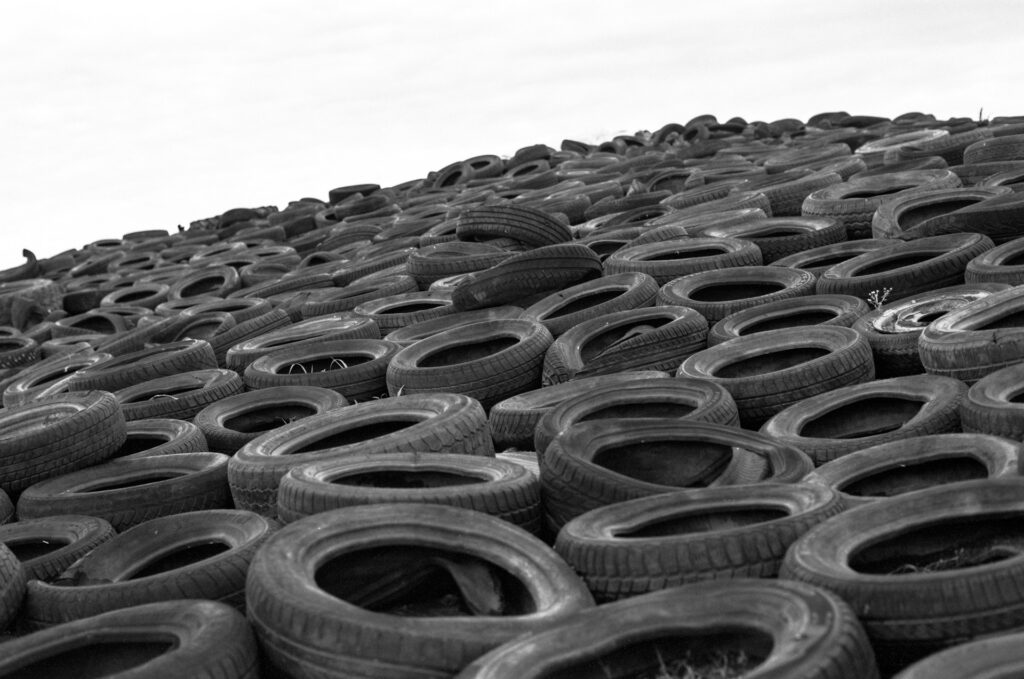
For decades, used tires symbolized one of the most corrosive environmental dilemmas of modernity.
Their apparent invulnerability, designed to withstand inclement asphalt, made them eternal waste, difficult to dispose of, dangerous to incinerate and problematic to store.
Today, that toxic inheritance has mutated into opportunity.
What used to be piled up in rubber cemeteries, today feeds a circular economy that turns waste into a resource, and garbage into infrastructure.
«Waste does not exist, only misplaced materials»
By: Gabriel E. Levy B.
For much of the 20th century, end-of-life tires were treated as a nuisance.
Huge clandestine landfills multiplied in the urban peripheries, generating health risks, spontaneous fires and polluting leaks.
The composition of the tyre, a mixture of synthetic rubber, carbon black, textile fibres and steel, prevented its efficient recycling for a long time.
According to data from the European Environment Agency, at the beginning of the 90s more than 3 million tonnes of used tyres were accumulated in Europe alone.
In the United States, the Environmental Protection Agency estimated that in 1990 there were more than one billion unprocessed discarded tires.
Its degradation could take centuries. Its incineration released dioxins and heavy metals. Its abandonment generated breeding grounds for mosquitoes and vermin.
But this history of pollution and passivity began to change in the 21st century.
The problem ceased to be exclusively environmental and became an industrial possibility: tires began to be seen as inadvertent deposits of valuable raw materials.
«The asphalt of the future is built with the garbage of the present»
The real metamorphosis of the used tyre began when civil engineering discovered a hidden promise in it. Beyond steel, which can be extracted with powerful hydraulic hooks and melted for the metallurgical industry, shredded rubber proved to have surprising applications.
One of the most revolutionary is rubberized asphalt.
This material is obtained by mixing recycled tire powder with bitumen and other aggregates.
The advantages are numerous: greater elasticity, less thermal cracking, better adhesion to water and greater durability. In addition, its sound absorption capacity makes it ideal for urban roads where you are looking to reduce vehicular noise.
According to the study «Rubberized Asphalt: Meeting Pavement Performance Goals While Protecting the Environment» published by Michael Heitzman in the Journal of Materials in Civil Engineering, this type of asphalt can last between 30% and 50% longer than conventional asphalt, significantly reducing road maintenance costs in the long term.
Brazil, Mexico, South Africa and Spain have adopted this technology in multiple projects.
In Andalusia, for example, the «End-of-Life Tyres» programme has made it possible to recycle more than 200,000 tonnes of rubber per year, which end up being converted into high-quality pavements.
In addition to road applications, recycled rubber is used in sports courts, shoe soles, acoustic insulation and even in street furniture. More and more industries understand that tires are not the end of one chain, but the beginning of another.
«A garbage with a market price»
The most interesting thing about the paradigm shift is not only ecological, but economic. Today, used tires are no longer given away free of charge: they are marketed.
Companies dedicated to recycling buy them by the ton, compete for access to landfills and design logistics systems to ensure the constant supply of this reconverted waste.
The researcher José M. Cabrera, in his work Circular Economy and New Materials, argues that «waste begins to be quoted when technological knowledge allows its value to be redignified in the production chain».
This «revaluation» implies a structural transformation: the end-of-life tyre ceased to be a liability and became a strategic asset.
Spain, for example, created in 2005 the SIGNUS Integrated Management System, which brings together tyre manufacturers and managers in an economic circuit of collection, transformation and reinvestment.
In 2022, the system managed to recycle 92% of the tyres collected, a figure that reveals the potential for well-articulated management.
This market logic also influences innovation. Companies such as Genan (Denmark), Liberty Tire Recycling (USA) or Life for Tyres (Spain) develop patented technologies to maximize the use of rubber, reducing emissions and generating jobs.
Garbage became business. And like any business, it requires efficiency, regulation and vision.
«From the tire graveyard to the race track»
The case of Kuwait symbolizes the before and after of this phenomenon. For decades, the country was home to the world’s largest tire dump: more than 42 million units stacked in the Sulaibiya Desert, visible from space.
The risk of fires and international pressure prompted the government to act.
In 2021, it initiated a plan to empty the landfill and transform tires into construction materials.
In Mexico, the Recycable treatment plant, located in León, Guanajuato, processes 80 tons of tires per day, separating steel, fibers and rubber in a fully automated circuit.
The final product is sold to asphalt companies and sports flooring manufacturers.
In South Africa, the REDISA (Recycling and Economic Development Initiative of South Africa) programme managed, before its closure due to irregularities, to employ more than 3,000 people in the tyre recycling sector, showing that the circular economy can also be inclusive.
In Argentina, the company Regomax leads the collection and recycling of end-of-life tires in Buenos Aires and other provinces. Although they still face infrastructure and regulatory challenges, the country is moving towards national waste regulation.
Even Formula 1 joined the circuit. The Pirelli company implemented a recycling system for all tires used during the season. What was once only used for racing, now returns to the track, converted into the basis for new industrial compounds.
In conclusion
The tire, a symbol of mobility, ended up trapped in its paradox: designed to withstand time, for decades it was unable to disappear. Today, that resistance has become a virtue. Rubber and steel that once collapsed landfills feed industries, create jobs and sustain roads. This renaissance is not only technical, but symbolic: it reveals that the future can be built with what the past discarded. It is enough to look at the wheel with different eyes.
References:
- Heitzman, M. (2017). Rubberized Asphalt: Meeting Pavement Performance Goals While Protecting the Environment. Journal of Materials in Civil Engineering.
- Cabrera, J. M. (2020). Circular Economy and New Materials. UPM Publishing.
- Domínguez, T. (2019). Waste Management and Circular Economy. University of Seville.
- European Environment Agency. (1995-2020). Reports on pneumatic waste.
- Environmental Protection Agency. (1990). Scrap Tire Management in the United States.